Construction budget
Your cost plan. Unlike a bill of quantities, it contains prices, and unlike a quote, you prepare it, not the supplier. During the build you compare it with the costs you record.
Construction budget guide
A construction budget shows which work and materials you are planning and how much they should cost. Here you will find what it should contain, how to put it together step by step and how to keep it in line with reality when changes and extra work come up during the build.
In Quotioo you split the build into items, add quantities and prices, and compare the plan with recorded costs as the work goes on.
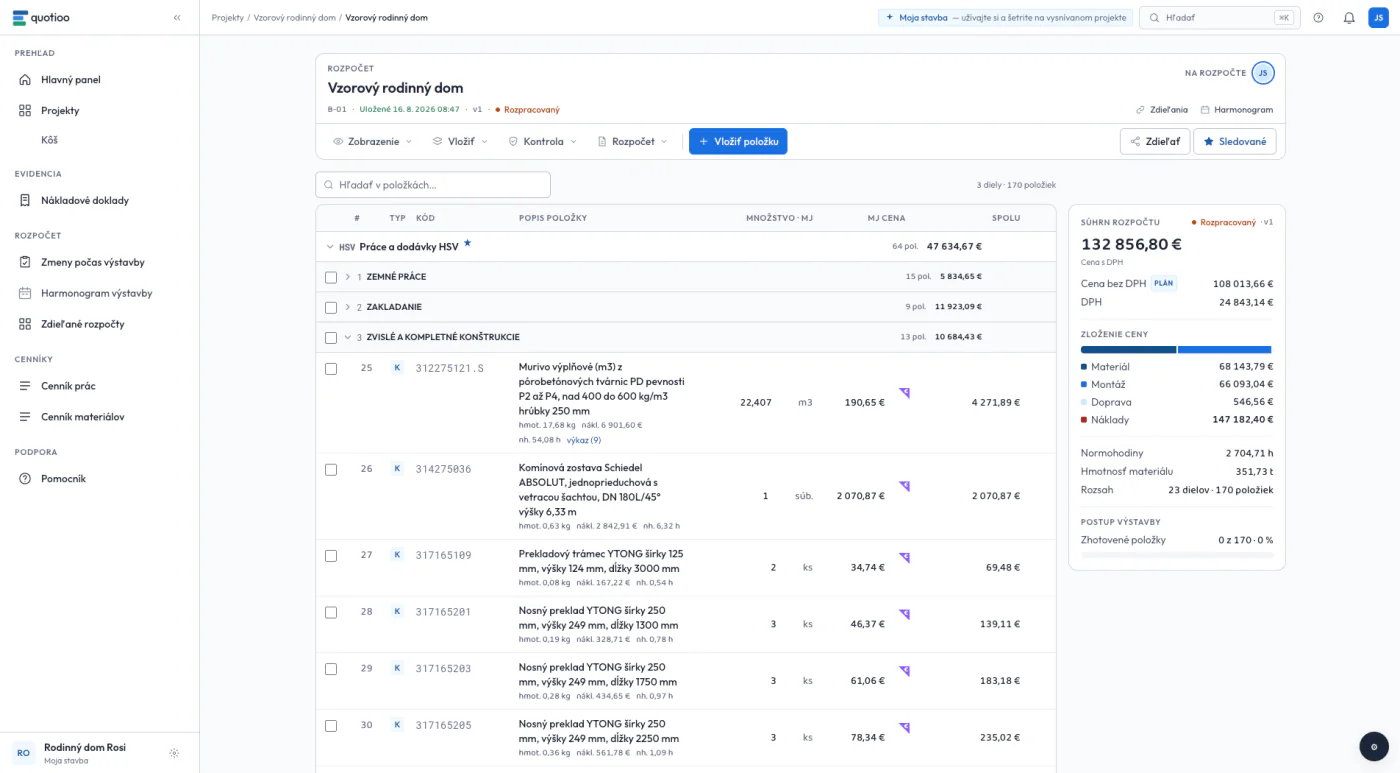
Budget editor
Itemised budget
Material and labour kept apart, with site costs next to each item
The basics
Short answer
A construction budget is a list of all the work and materials needed for a new build or renovation, with quantities, unit prices and a total. It answers two questions at once: how much the build will cost and what that sum is made of. The second part matters more, because without a breakdown the price cannot be checked, compared with quotes or defended when negotiating with a supplier.
Before work starts, the budget tells you whether you can afford the project and where the most expensive parts are. At this point you can still change the scope, the materials and the standard, because nothing has been bought or built in yet.
This is the stage when the budget is the cheapest tool you have. A change on paper costs time, a change on a half-built house costs money.
When everyone you ask has the same list of items and the same quantities, their quotes can be compared line by line. Without that you are comparing four different briefs, and the lowest figure is often just the least complete.
A breakdown also protects you from items that were “not mentioned” in the quote and only appear on the invoice.
As the work goes on, you assign actual spending to each item, meaning invoices and receipts. For every stage you see how much cost you have recorded so far and how far it is from the plan.
This turns the budget into a living document. You spot an overrun during the build, not at the end when the final account is settled.
An itemised budget is a list of lines, and every line has the same structure. Here is one of them, as it looks in Quotioo.
| Code | Item name | Unit of measure | Quantity | Material price | Labour price | Total |
|---|---|---|---|---|---|---|
| 311 | External masonry wall, 300 mm thick | m² | 86 | €24.10 | €14.40 | €3,311 |
Example
A budget is first split into building elements and stages, and only then into individual items. That way you know which part of the build takes the most money before any work begins.
| Building element | Items | Material | Labour | Total | Share |
|---|---|---|---|---|---|
| Foundations and groundworks | 24 | €21,400 | €11,600 | €33,000 | 18% |
| Load-bearing walls and partitions | 42 | €31,750 | €15,750 | €47,500 | 25% |
| Floor slabs | 24 | €12,600 | €7,400 | €20,000 | 11% |
| Roof structure | 28 | €14,950 | €8,550 | €23,500 | 13% |
| Roofing | 36 | €17,250 | €6,250 | €23,500 | 13% |
| Windows and doors | 18 | €17,900 | €4,100 | €22,000 | 12% |
| Paving and external works | 16 | €9,850 | €5,650 | €15,500 | 8% |
| Total | 188 | €125,700 | €59,300 | €185,000 | 100% |
The figures come from an example budget we use for demonstration, not from a market price list. Real prices vary by region, supplier, time of year and the material you choose, so always build your budget on prices you can check.
In this example, material makes up 68% and labour 32% of the total. The ratio changes depending on what you do yourself and what you order.
That is exactly why prices should be kept apart. When material gets more expensive you see it straight away, without guessing whether the installation price changed.
The breakdown shows which parts make up the biggest share of the price. When you adjust the scope or compare quotes, you can see what a particular change means for the whole budget.
It also shows where saving does not pay. On foundations, waterproofing and the roof, a later repair usually costs more than you saved.
Cost of a build
There are two answers to the question of how much a build costs, with different levels of accuracy. A rough budget tells you whether you can afford the project. An itemised budget tells you exactly what you will be paying for.
Short answer
You can calculate the cost of a build roughly from the floor area and a price per square metre, or precisely as the sum of all budget items plus ancillary costs and a contingency. A price per m² is quick, but it does not know what the total is made of. To choose a supplier, apply for a loan and control costs during the build, you need an itemised budget.
These are not two competing approaches but two stages. A rough budget is the first step, and an itemised budget replaces it once you have drawings.
| Aspect | Rough budget | Itemised budget |
|---|---|---|
| How it is calculated | Floor area multiplied by a price per m², or the enclosed volume of the building multiplied by a price per m³. | The sum of all items: quantity multiplied by the unit price of material and labour. |
| What it is based on | A design study or a standard house design, plus the prices of similar builds in the region. | The project drawings, the bill of quantities and a price list or supplier quotes. |
| When it is useful | Before you buy a plot or a design, when you are deciding whether you can afford to build. | When choosing suppliers, applying for a loan and throughout the build to keep costs under control. |
| What it cannot do | Compare quotes or track spending. It does not know what the total is made of. | Give a quick first estimate. Without drawings you cannot put one together properly. |
An itemised budget calculation, worked through. One item: 86 m² of external masonry multiplied by (€24.10 material + €14.40 labour) comes to €3,311. The whole build: the sum of all items, €185,000 in the example budget above, plus ancillary costs and a contingency, which at ten percent adds another €18,500. Quantities come from the bill of quantities, unit prices from the price list of work and materials or from quotes.
The plot, utility connections, project drawings, fees and permits, and often paving, fencing or a fitted kitchen too. With any price per m², ask what exactly it includes.
Two identical prices per m² from two firms can therefore mean two completely different scopes of work.
The size and shape of the house, the standard of materials and technology, how much work you do yourself, and the region and time of year in which you commission the build.
An irregular floor plan or a complicated roof makes a build more expensive than the floor area alone suggests, because it adds metres, corners and details.
From a current price list, from supplier quotes on the same bill of quantities and from invoices for similar work. Always double-check prices that are more than a year old.
Step by step
Seven steps that apply equally to a new build and a renovation. The first six put the budget together, the seventh turns it into a tool that genuinely helps you during the build.
Write down the type of project, the footprint, the number of storeys and the standard of finish. A budget without a clear scope cannot be compared with any quote, because the brief quietly changes with every question.
Shell and core, roof, windows and doors, services, finishes and external works. Stages are the backbone of the budget. Later you track costs by part of the build, not as one large sum.
For each building element, add the quantity in its unit of measure: m², m³, linear metres, pieces or sets. This list of quantities without prices is called a bill of quantities, and it is the most laborious part of the whole budget.
How a bill of quantities is put togetherTake prices from a price list, from invoices for similar work or directly from supplier quotes. Keep material and labour in separate columns. Otherwise, when prices rise, you will not know whether the material or the installation went up.
How to read a price list of work and materialsDelivery of materials, scaffolding, skips and waste removal, utility connections, inspections, project drawings and fees. These are the items most often missing from first budgets, and together they make up a noticeable share of the price.
For a new build, a contingency of around ten percent is common. For a renovation, allow more, because once structures are opened up you often find something you did not expect. A contingency is not a sign of a bad budget. It is part of it.
Once work starts, assign invoices and receipts to the budget items. Only then does the budget really work for you, because you see a deviation while there is still time to do something about it.
The hardest line is the first one, not the last. That is why in Quotioo you do not start with an empty table, but with an Excel file from your designer, a template or a description of your project. Getting started with a budget
Key terms
These three terms are used interchangeably when talking to designers and suppliers, and most misunderstandings about the cost of a build start right here. This is the difference between them.
Your cost plan. Unlike a bill of quantities, it contains prices, and unlike a quote, you prepare it, not the supplier. During the build you compare it with the costs you record.
A list of quantities without prices: how many m² of masonry, m³ of concrete or windows. It feeds into the budget and is also the document suppliers add their prices to.
How a bill of quantities is calculatedThe price a specific supplier asks for a specific scope of work. The budget is your plan, a quote is the market's answer to it. Quotes can only be compared when they price the same bill of quantities.
How to compare quotesA budget broken down into individual items, each with a code, unit of measure, quantity and unit price. It can be checked, queried and compared with another quote.
A broad estimate based on a price per square metre of floor area or per cubic metre of enclosed volume. It helps you make a first judgement before buying a plot or a design, but it is not enough to run a build.
Work that was not in the original budget and only came up as the build progressed. It is not a budgeting mistake. The mistake is when it is never written down and only appears on the final invoice.
How extra work changes the budgetWhat to watch out for
Budgets rarely fail because one item was priced wrongly. They fail because of what is missing from them, and because nobody looks inside again after signing.
A missing item overruns the budget just as much as a badly estimated price, it simply shows up later and more painfully. Renovations often forget demolition and the removal of rubble.
Start from a template, not a blank sheetA budget that exactly matches what you can afford is a budget that will not hold. The first surprise pushes it over, and you end up deciding under pressure instead of to plan.
When an item has only one price, you cannot tell what changed when it goes up, and two quotes from two firms cannot be compared fairly.
Why labour and materials are kept apartA catalogue price without delivery, installation, fixings and waste is only half the story. Always check a price for the full scope you will actually pay for.
Without recording actual spending, a budget is just a historical document. You find out about an overrun only when it is too late to do anything about it.
Extra work without a written record and an agreed price is the surest route to a disputed invoice and to arguing about what you actually agreed.
How to record extra workBudgeting in Quotioo
Quotioo is for people who manage their own build or renovation. It helps you prepare a budget, compare quotes from tradespeople and keep track of changes and costs while the work is under way. You can prepare a budget and a bill of quantities on the free plan. Cost tracking, quote comparison and change orders are part of the paid plans.
Have a budget from your designer in Excel? Upload it and check the items Quotioo recognises. If you are starting from scratch, pick a template or describe your project and Quotioo suggests a first list of items.
See the three ways to startSearch for a type of work or material and use the price list price as the starting point for your budget. For your specific build, adjust it to the material you choose and the supplier's quote.
See the price list of work and materialsHas your builder proposed extra work? Record its scope, reason and price in a change order. Once approved, a new budget version is created and the original is kept.
See how a change recalculates the budgetAssign each receipt or invoice to the item it belongs to. You see the plan and the recorded costs side by side as you go, not only at the end of the build.
See expense trackingFrequently asked questions
Answers to what people ask when they are building or renovating for the first time.

Cannot find your answer?
Write to us →For a new build, it is usually prepared by the architect or a cost estimator as part of the project documentation, often together with a bill of quantities. For a smaller renovation you can prepare it yourself from a template or a description of the project, and take prices from a price list or from tradespeople's quotes. If you have a budget from your designer in Excel, you do not need to retype it. Upload it to Quotioo and check the items it recognises.
Do not start with an empty spreadsheet. Take an existing structure, such as a budget template or the budget from your designer, and adjust the quantities and prices to your project. Work through the build stage by stage: add the quantities for each stage, then material and labour prices, then ancillary costs and finally a contingency. A budget is more often ruined by an item that is missing altogether than by a badly estimated price.
For a rough figure, multiply the floor area by the price per square metre of similar builds in your region. A reliable price only comes from an itemised budget that adds up every item, plus ancillary costs and a contingency.
The budget is your cost plan, a quote is a specific supplier's response to that plan. You have the budget prepared or prepare it yourself, and you use it to manage the whole build. A quote applies to one supplier, one scope of work and usually a limited time. Quotes can only be compared fairly when they are based on the same bill of quantities.
For a new build, a contingency of around ten percent of the total is common. For a renovation it is usually higher, because you only see the real condition of the structure once it is opened up. A contingency is not an admission that the budget is wrong. It is the item that stops the first surprise from bringing the build to a halt.
For a loan to build or renovate, banks usually ask for a construction budget and release the money as stages are completed. Requirements for the form and level of detail differ from bank to bank, so ask your bank for its exact requirements before you have the budget prepared.
Yes. Excel is enough to put a budget together, and most budgets are made that way. The problem comes during the build, when quotes, invoices, receipts and changes pile up against the items. One sheet turns into several versions that nobody can keep in sync. So if you received your budget in Excel from a designer or cost estimator, upload it to Quotioo, check the recognised items and carry on without retyping anything.
By assigning costs from invoices and receipts to the budget items as you go. Quotioo compares the approved budget with the recorded costs and shows the deviation for each item and each part of the build. A positive deviation means costs have exceeded the budget. Alerts follow the deviation threshold you set. In Quotioo this check is part of the Construction plan and above. Budget overruns rarely happen all at once. They build up from small changes that nobody added up in time.
Read next
A budget rests on quantities, unit prices and supplier quotes. We cover each of these parts separately, with an interactive example.
Who can prepare a budget for you in Slovakia, and what the project documentation behind the budget is based on.
Ready for your build
Start with what you already have and add the items of your project as you go. You can put the budget together on the free plan. Quote comparison and cost tracking during the build are part of the Construction plan.
Want to see how it works first? Have a look at the examples on the home page.
Updated